
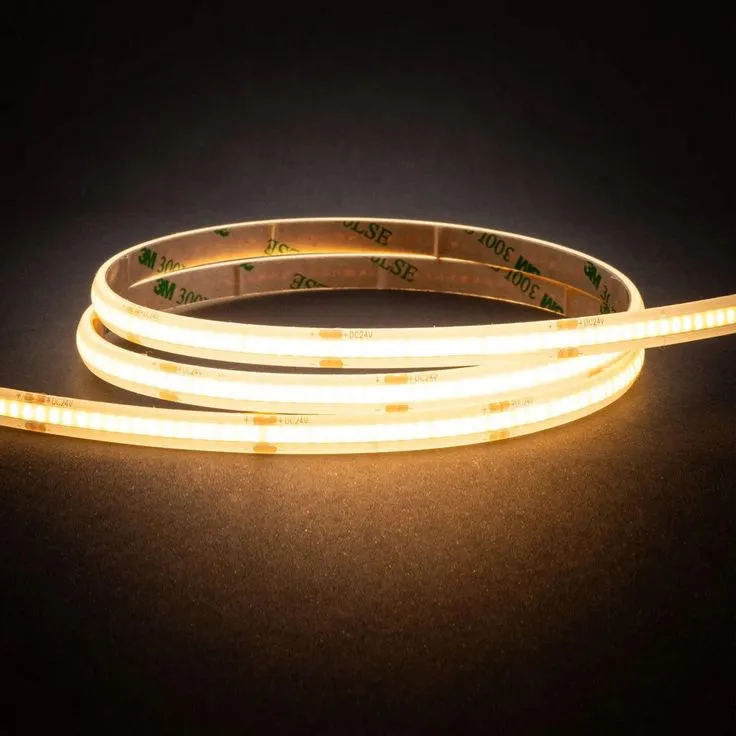
Though creating continuous, smooth lighting is a possibility with COB LED strips, the strip is just a portion of the lighting system. The driver is required to provide appropriate electrical power and comply with the requirements for voltage, watts and control of the strip. It is particularly critical to select a driver that is compatible with architectural and commercial fixtures that could be in use for extended hours. With careful selection, such as a field test, stable performance and manageability of the entire system can be achieved.
Check the Strip Voltage
The first step is to find out the strip’s operating voltage of the COB. For common low-voltage LED systems, the voltage can be 12V or 24V, but the voltage of the driver must match the voltage that is specified in the LED product.
The size and output rating of an LED driver for COB LED strips are never the only criteria used in choosing the driver. The input and output specifications should be the same as the lighting system.
An incompatible voltage can impact performance and can cause unnecessary electrical issues. It’s important to check the strip specifications before ordering the driver, especially when replacing an already installed strip.
Calculate Total Power
The driver should be able to carry the entire length of LED strip to be installed. First of all, check the strip’s watts per meter and then multiply the total installed length by this number.
For instance, in a project with multiple sections, the electrical load of the project should be taken as a whole load for planning the electrical power system. Depending on manufacturer’s recommendations and installation conditions, additional capacity may be necessary.
Do not choose a driver that is always running at its maximum rating. Fitting out the system with appropriate capacity will provide additional operating space and provide a more stable operating environment.
Consider Dimming Requirements
The type of control required for an LED installation is not always the same. Some projects involve a simple on/off switching; others involve a dimming switch to be used in different activities or at various times of the day.
When the light must be compatible with a system that has dimming, a dimmable driver for COB LED strips could be an option. But the driver, controller, dimmer and LED strip need to be coordinated.
Determine the type of control that will be needed for the project prior to choosing a dimmable option. Each system may employ a different type of dimming, so compatibility needs to be checked prior to system installation.
Think About Installation Conditions
The operating environment of the driver may be affected by its location. Airflow for drivers in enclosed areas such as cabinets, ceilings or furniture could be less than in open areas.
Follow the manufacturer’s guidelines for ventilation, mounting position, temperature and enclosure requirements. There also needs to be sufficient room for wiring and future inspections.
If the driver is available, it can be helpful for commercial projects, as the maintenance team may need to take out, inspect or replace the component without touching completed architectural surfaces.
Plan the Electrical Layout
The longer the installation of light, the greater the planning needed. The placement of the driver should be taken into account for the LED strip, cable path, connection point and power supply.
The length of the cable and the size of the conductor may affect the voltage performance, especially in large installations. Break up the lighting into appropriate sections, as needed, and arrange power connections as recommended by the manufacturer.
A clean electrical wiring system can also be easier to maintain in the future. When using multiple LED zones that can be controlled independently, it is helpful to label connections and provide a wiring diagram.
Check Driver Quality
A driver is an important component of the lighting system, and the basic specifications should not be neglected. Consider efficiency, safety and security options, temperature range, enclosure design, and certifications.
There may also be specific safety or compliance requirements related to the project that must be met for commercial installations. It is recommended these requirements are checked prior to selection of the driver and not after installation of the lighting.
A driver that meets the electrical needs and environment in which it will be used is required.
Match the Driver to Controls
For projects requiring smart or architectural lighting controls, extra compatibility testing is required. One person’s method of dimming may be different from another’s.
For wall controls, automation or a centralized controller, ensure that the driver you selected can be used with the control signal utilized by the system. This is especially critical if there are several light zones that require coordination or individual control.
As the driver plans, they can avoid compatibility problems when they are getting ready to commission in the planning process.
Conclusion
Test the entire lighting system before closing ceiling, cabinets or wall cavities. Test brightness, dimming sensitivity, connections and normal operating temperature. It is possible to test for an unsuitable driver before it is difficult to get access. It also provides a chance for the installers to verify that the lighting segment operates properly with a selected control system. For professional projects, it is also easier to serve the project in the future if the final configuration of the driver model, load and wiring of the project is recorded. The selection of an appropriate driver boils down to ensuring it meets the electrical, control and installation needs of the entire LED system. For those who need to find a suitable driver as well as other drivers and related lighting elements, richeelighting.com offers some choices based on various COB LED applications.